 Apparently Bruno Loubet’s eight year absence from London has only made our hearts grow fonder. When the story broke last year that the chef was returning to our shores, Twitter was abuzz with the news.
For those of you who didn’t try Loubet the first time around, when his CV included Le Manoir aux Quat’ Saison, The Four Seasons on Park Lane – where he won his first Michelin star – then at Bistrot Bruno and L’Odeon, you’ll now get a second chance with Bistrot Bruno Loubet at The Zetter Hotel.
Hot Dinners caught up with Bruno in the last stages of planning for the opening.
You must be very busy at the moment with just days to go till launch. How’s it all coming together?
Bruno Loubet: Things are coming along. We’ve been lucky to have time to organise ourselves, plan stuff which is quite unusual for a new restaurant – these things always open at the last minute. There’s always the last minute problems and surprises, but overall it’s very good.
What can you tell us about the menu?
It’s obviously reflecting what I’ve done in the past but also what I like to do today. So it’s a bit of a mixture of the old classics and some new ideas which I’ve liked and have developed over the years and while I was in Australia. It’s all the food I’d like to eat myself or see on a menu – it’s kind of personal. If you do what you believe in, not what you think you should do, then everything should be good.
It looks as if you’re going to use a lot of good British produce.
At the end of the day, wherever it comes from, if it’s good that’s what comes first. Obviously if I can get something from Cornwall instead of the South of Italy, I’ll take it from Cornwall because it’s not as far. We all have a bit of a conscience these days and all want to do the best we can with the way we work. But if I don’t find it in Cornwall and it’s in the South of Italy and I can get and afford it, I’ll take it. For me the quality dictates where food comes from.
We were pleased to see Hare Royale on your launch menu [a complicated dish which, depending on which version the chef follows, involves a lot of wine, garlic, hare blood or fois gras and results in either a stew or ballotine so tender the hare can be eaten with a spoon).
It’s a dish I love, because to me it represents old French gastronomy at its height – obviously I don’t have a ton of fois gras in it because I can’t afford it and then we’d have to sell it at £25 or £30. But I decide to have Hare Royale slightly simplified, where it still has massive flavours in it. It’s a beautiful old-fashioned dish, which I’ve slightly modernised with the garnish. Usually it’s served with pasta - buttered taglatelli or something like that – here it’ll be served on a nice onion raviolo because onion goes with the rich sauce and the rich meat and to give it a modern touch. You can’t make light of it – rich is rich you know - but we’ll have a little puree with mandarin which just gives it a little fruitiness. There’s sweet and savoury.
It’ll be on the menu for about a month or a half at most. I think it’s an amazing dish. I’ll try and keep it as long as I can until Spring arrives.
We’re a French bistro. A modern bistro I’d like to say, because French bistro carries the image of doing certain clichéd things and I don’t like clichés.
What are the differences between the kind of cooking you’ve been doing in Australia and what you’re planning for London?
Queensland is obviously very different to London in what they eat and what they like – the weather makes a major difference. It can go up to 40 in summer and at those sorts of temperatures you eat differently than if you were in London.
Is your time there going to inspire what we see on the menu at Bistrot Bruno Loubet?
Produce-wise, there are things I would like to use straightaway, but I’m not going to and the reason for that is I don’t want to send the wrong message at the beginning. Because if I start to do things with Australian products, people will say; ‘Oh Bruno has changed, blah, blah’. They may even associate me with Pacific Rim which you have to be conscious and careful about. I’m going to use bits and pieces – but very lightly.
When people hopefully feel "Bruno is back and he’s doing Bruno" but maybe a bit different because ten, twelve years down the line he will be different - then, when I’ve got the confidence of the people, I’ll put Australian products on the menu. It won’t be a major thing because we’re a French bistro. A modern bistro I’d like to say, because French bistro carries the image of doing certain clichéd things and I don’t like clichés.
We’re going to be doing something a bit different, you know? I keep all the references . For example, we have an onion soup – but it’s done with a beef stock which has cooked for six hours. The onions have been caramelised for an hour and then they’ve been covered with cider and reduced down. Then the two of them are put together and cooked for another hour. That’s your soup and then you do a soufflé instead of putting bread on the top. You end up with a soufflé of emmenthal cheese – it’s lighter and much more interesting. Yes it’s an onion soup with cheese – but it’s a world apart.
Back in the 90s you were at the top of your game here in London. What made you leave all that behind and move with your family to the other side of the world?
I left London for a lot of personal reasons. I was a bit burned out – I worked like crazy for 15-20 years, making a lot sacrifices, working all the time, really focusing on what I was doing.
I did bistro, brasserie, fine dining, Michelin star, I worked with Raymond Blanc, etc. and with each thing I did I felt I really achieved something. So it was very hard because people have expectations - the guides, the press, the customers, the people you work with – it’s a lot, you know? So I arrived at the point where I was a bit saturated - in my head, physically, everything.
I was burned out, so that’s why I decided to leave. I wanted to be in my own space. I put myself back together and then decided to come back.
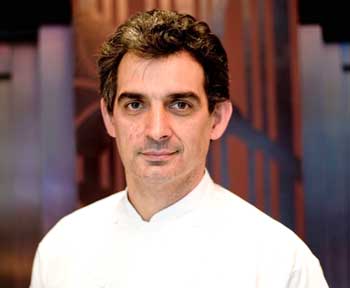 Were you lured back to London by the overtures of The Zetter’s owners Mark Sainsbury and Michael Benyan?
Not at all. I was coming back to open a pub in the country – what you call a gastropub these days. A pub with good food. I was looking for premises with a garden so I could have chickens and some pigs – living the chef’s dream, what all chefs, I think, aspire to. After quite a while in the business, you want a little more ease to do what you want and I love the country. So that was my aim.
We arrived, we looked around some properties and we were going to go for it. Then Mark and Michael came along and contacted me. We talked for a few months. (Initially) I didn’t want to come back to London. I wanted to stay in the country and then I thought, ‘Why not?’ It sounded good, I liked them and that’s the truth. I thought they were very nice guys and had the right ideas and I hadn’t seen many people like them with the view they have of the business.
So I thought I’d do this and see how I feel after five years. Obviously, I’m getting older – I’m 48 now!
So when The Zetter denied the story in The Times that you were on board, was that because it took you a long time to decide to make that leap to London?
Yes, the negotiation has been a long one!
Almost the moment you arrived back in the UK you were approached by Pierre Koffman to work with him on his Selfridges pop-up for the London restaurant Festival. That sounds like a baptism of fire.
I was there just under two months working with Pierre and it was great. For me what a comeback – straightaway in the deep end, working very hard, doing great things and being in front of all the cameras. Obviously they were coming for Pierre, but I think they were quite surprised to see me in the kitchen working hard! It was quite an event – we arrived and four days later we opened the restaurant doing 240 covers a day at a high standard. It would be hard for anyone to do. Eric Chavot was also there with us and we shared the work. We really needed each other, we couldn’t have done it on our own. From day one we were like the musketeers – one for all, all for one.
It sounds as if the experience energised all three of you. You’re opening The Zetter and both Pierre and Eric are now looking to open new restaurants.
It was brilliant. I’d come back, after ages in Australia, to London which is one of the food capitals of the world. You’d be crazy not to be worried, thinking ‘Am I still good enough?’ and ‘Can I do it?’ So coming back and working with Pierre and Eric at Selfridges where I ran the meat and sauce on my own was a good test for me.
The old men still had it - most of the young guys around couldn’t have done that – and it boosted my confidence. It was an incredible mission – I’m sure it energised everybody.
From day one Pierre Koffman, Eric Chavot and I we were like the musketeers – one for all, all for one.
Are you aware of any major changes to the London restaurant scene since you’ve been away?
I don’t feel it’s changed a lot. People tell me it’s changed completely, but food-wise I don’t see a massive difference. OK now there is one other direction added – molecular gastronomy – that’s something new that wasn’t there before. The only difference is that there are many more restaurants offering value for money than there used to be. There are a lot of people trying to achieve the best food possible at the best price. Everyone’s looking to do something more simple and value for money seems to be the name of the game. And in my book, that’s what I used to do.
I feel like I’m coming back home because that’s what I used to do with Bistrot Bruno and L’Odeon.
The menu at The Zetter seems keenly priced?
If you consider the quality we’re going to pull out of this kitchen – this is the price of a gastropub. I try to have quality and good price and good fun on the menu.
What’s your favourite place to eat in London right now?
(Without a moment’s hesitation) Terroirs. I think it’s a fantastic place because there’s absolutely no pretension. It’s excellent food – I love the idea of the charcuterie. Everything is so simple, but done with the heart. It’s like eating with your family in France. I like the atmosphere, the service is excellent. I like everything about it.
When you were last in London you published a number of very well-received books. Are there any plans for more?
Definitely. When I arrived in Australia about six months later I was contacted by Penguin about doing a book, but I said I didn’t want to until there was a good enough story. For me now, here, this is a new chapter. I hope we’ll be very successful here and I’ll have a lot to say – I think that could be a good story, with plenty of recipes and talk.
The restaurant is open now - Find out more about Bistrot Bruno Loubet